
 English
 中文


The development of composite industry is changing with each passing day.
Polyurethane resin has the advantages of good toughness, fast curing, environmental protection and no volatilization.
In the past, it was dominated by unsaturated resin and epoxy resin for a long time.
Is gradually being replaced ...
Advantages and disadvantages of resins commonly used in composite materials
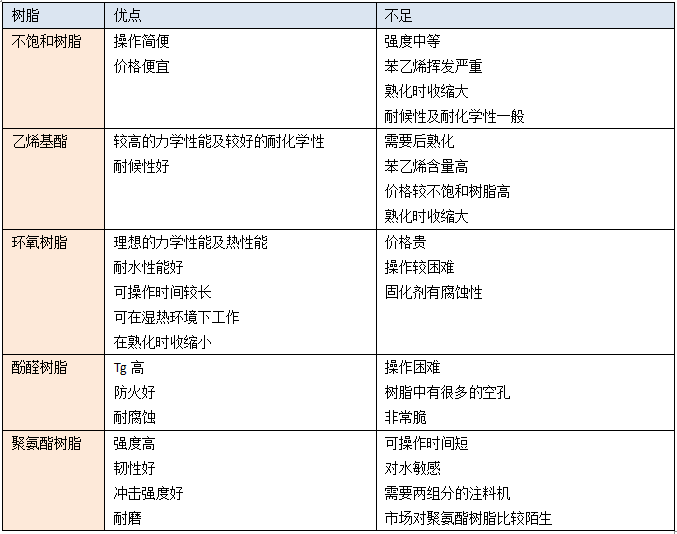
Advantages of polyurethane composites

Development of Polyurethane Composites
In 1937, Otto Bayer in Germany invented polyurethane.
In 1960s, Bayer and Swiss company CIBA developed RIM (Reaction Injection Molding Process).
In 1970s, GE Company of the United States introduced RIM automatic line; Glass fiber began to be used for RIM reinforcement.
In 1980s, S-RIM (Structural Reaction Injection Molding Process) appeared. China has introduced RIM technology.
For more than 20 years since 1980s, RIM has been the main technology of FRSP polyurethane composite.
Up to now, fiber reinforced polyurethane composites have developed long fiber injection (LFI), pultrusion, winding, resin transfer molding and other processes, mainly using non-foaming polyurethane composites to produce window frames, telephone poles, bathtubs, large automobile parts and other products.
The development of technology makes the applicability of polyurethane composites wider.
1.R-RIM (Reaction Injection Molding)
The standard RIM is not reinforced, and the reinforced RIM can be divided into R-RIM and S-RIM according to different reinforced materials.
R-rim (reinforced reaction injection molding): reinforced by powdered materials such as ground glass fiber.
S-rim (structural reaction injection molding): reinforced by glass fiber fabric, chopped/continuous felt and preform.

VFI(Variable Fiber Injection): In order to overcome the shortage of SRIM pre-laid felt and limited glass fiber addition (glass fiber content increases, resin fluidity decreases, and there are small bubbles), Germany and Italy developed VFI, which directly dispersed glass fiber roving into the mixing cavity, and then injected into the mold with polyurethane for curing and molding. Compared with S-RIM process, VFI high-density products have better performance.
2.LFI (long fiber injection molding)
LFI (Long fiber Injection) is mainly used to produce interior parts with lower requirements on mechanical properties but more complicated design, such as instrument panel, interior trim panel and body floor.
In this process, the cutting machine cuts 25-50 mm long chopped yarn from the plied yarn and inputs it into the temperature control mold. At the same time, the mixture containing isocyanate, polyol and catalyst is also input into the mold. LFI can efficiently produce lightweight and high-strength polyurethane parts.
LFI is an interesting alternative to S-RIM. LFI is basically a one-time operation, while S-RIM needs multiple processes: preparing glass fiber felt, laying the felt into the mold, and then injecting polyurethane. Because fiber and resin are input simultaneously in LFI process, the molding time is shorter. LFI has higher glass fiber content than S-RIM, and is also suitable for more polyurethane formulations, which can make lighter products with better performance.
Polyurethane composites made by LFI process were first used in automobile industry for structural and semi-structural plates, such as roof components. It is reported that the LFI polyurethane roof of a sports car is 20% lighter than the steel roof and more than twice as rigid as the aluminum roof or other FRP roofs.
In agricultural and commercial vehicle industries, LFI polyurethane composite materials are used for tractor covers, heavy truck plates, bulldozer outer body panels, bus luggage racks and so on.

① tractor hood

② Bus luggage rack
3. FCS (fiber spray molding)
FCS (Fiber Composite Jet) technology of polyurethane composites is a novel solution. Can be applied to the market of large-scale fiber composite products. Typical applications are body parts of general-purpose vehicles (such as buses, tractors, etc.) and windshields and cabs of trucks, and there are also many potential applications in the construction and infrastructure industries.

Truck windshield
Hand-paste method is still very common in the production of composite products. The obvious advantage of hand-paste method is that it has the lowest equipment cost and can manufacture products with very complicated shapes. Its disadvantages are high labor cost, long cycle and unstable product quality. In addition, the styrene discharged in production is harmful to health, and in order to reduce this risk, it is necessary to increase the operating cost. The fiber composite spraying technology can not only meet the production requirements of products, but also avoid the unfavorable factors in the hand-pasting process to a certain extent, and can obtain products with superior quality.
The 4-component mixing head used in FCS process provides the possibility of selecting a variety of materials. For example, by choosing different polyols (up to 3 kinds), the dense layer and foam layer can be compatible in the same product. The foam layer can reduce the weight of the product and improve the acoustic performance. Another variation is to use two different polyols and two isocyanates. In other words, the system can be made into two completely different polyurethane systems. For example, the outer layer of the product is made of aliphatic polyurethane and the inner layer is ordinary polyurethane.
Baypreg method
This is a manufacturing process of sandwich panel. Paper honeycomb and other core materials are buried between two layers of glass fiber felt, sprayed and impregnated with two-component polyurethane, then compressed and heated in a closed mold for curing. This kind of board is lighter than other sandwich products, so it is very attractive for automobile and other uses. Typical uses are car body floor, luggage compartment floor, spare tire cover, skylight board and so on.

Skylight panel
Baypreg can be reinforced with various fiber materials such as glass fiber, carbon fiber or natural fiber. Suitable for all kinds of compression molding processes, compatible with all kinds of core materials, and no solvent is used in the whole process.
Multitec method
This is an updated open-die injection technology. The mixture of chopped glass fiber and fast-curing polyurethane is sprayed into the mold at room temperature and cured in the open mold.
Manufacturing a small number of parts can be sprayed manually, while mass production can be sprayed automatically by manipulator. Typical products of this process are hydrotherapy equipment, fish tanks, shower trays, recreational vehicle parts, tractor shields and fenders.

Hydrotherapy equipment
4. Pultrusion molding
In recent years, pultrusion molding of polyurethane has been commercialized. The pultruded manufacturers in North China saw the fierce competition in the pultruded products market in the United States, hoping to seek development opportunities through the higher toughness and strength of polyurethane.
In the process of pultrusion of polyurethane, more reinforcing fibers can be used to greatly improve the strength of products. At the same time, due to the excellent impact strength, tensile strength and interlaminar shear strength of polyurethane itself, products can be made thinner and lighter. For example, the thinner I-beam can be made with less continuous felt and more roving, while keeping its longitudinal stiffness unchanged, which not only reduces the weight, but also reduces the cost. In addition, polyurethane pultruded materials are less brittle and can be assembled in a conventional way without cracking and crushing.
Polyurethane pultrusion materials include profiles, bars and plates, such as ladder poles, tool handles, telegraph pole cross arms, telegraph poles, hockey poles, container plates and so on.

① ladder pole

② Container plate
The latest application of polyurethane pultruded material is door and window system, which can make larger, thinner and strong profiles for large window frames and even curtain walls. This kind of window frame is better than aluminum, wood and plastic window frames, with good expansion and contraction performance and good weather resistance, and the appearance can be painted to form a wooden appearance.
Another new use is railway sleepers. Japan Jishui Chemical has successfully used it in railway construction, and the polyurethane resin used is from Kostron. This kind of sleeper looks like wood and combines all the advantages of natural products and modern design. It can be sawed, planed, nailed, screwed and glued with common woodworking tools. Its thermal expansion coefficient and thermal conductivity are very low. Because of fiber reinforcement, its compressive strength, tensile strength and bending strength are very high, and its service life is more than three times longer than that of traditional sleepers. The closed-cell mechanism used in it will not affect its electrical insulation performance even if it absorbs little water in heavy rain. Its weight and field processing performance are also much better than that of concrete, and it can be made into any length without making another mold for each length. In addition, it is very environmentally friendly, does not use solvents when manufacturing, and can be recycled after the end of its life cycle. This kind of sleeper is used on the tracks of the famous high-speed train 'Shinkansen' in Japan.

Railway sleeper
5, winding and forming
Using polyurethane instead of polyester in winding molding has aroused great interest from polyurethane suppliers. A major breakthrough is that RS Technology Company of Canada used its proprietary patent technology of polyurethane resin and fiber winding to manufacture assembled composite telephone poles. This is the first polyurethane composite telephone pole. Polyurethane composites can make longer poles, while polyester composites are mostly used for smaller poles. The inner layer of this telephone pole is made of aromatic polyurethane, and the outer two layers are made of aliphatic polyurethane. This resin system has higher strength and toughness, reducing the weight by 45%.
BASF has been very active in polyurethane winding molding, especially in Europe, and its target use is corrosion-resistant 'long-term infrastructure'.
Another potential application field is corrosion-resistant pipelines and drinking water facilities in the Middle East and Southeast Asia. Hot water tanks also have great development prospects. The bursting strength of the water tank made of polyurethane composite material is 40%-50% higher than that of polyester water tank by winding molding process.
6, resin transfer molding (RTM)
Resin transfer molding (RTM) technology has been used to manufacture composite parts for decades. The resins used in this process include polyester, vinyl ester and epoxy resin. Kostron is committed to the development of polyurethane resin in RTM process. In RTM process, the fiber glass mat is placed in a double-sided mold. Polyurethane resin is injected when the mold is closed. When the part is cured, the mold is opened again to get the final part.
Vacuum pouring molding is a form of RTM, which allows vacuum to suck resin into the mold through fiber infiltration instead of injecting it into the mold. Vacuum pouring molding ensures the complete infiltration of fiber glass mat and eliminates dry spots that may cause component defects.
It is reported that the progress of extending the service life of polyurethane to more than 30 minutes has made it possible for various pouring molding processes. Both Huntsman and Kostron have developed polyurethane resin suitable for vacuum injection molding.
The physical properties of polyurethane composites manufactured by RTM process are better than those of other resins such as unsaturated resin or vinyl ester. They are often used in explosion-proof, bullet-proof and sports equipment.

Riot shield
Polyurethane composites: some promising application fields
1. Wind turbine blades
Adopting technology: vacuum perfusion molding.


In April 2016, Kesichuang successfully trial-produced the world's first 1.5MW new high-performance polyurethane resin system fan blade. This 37.5-meter-long polyurethane blade, which weighs about 6 tons, is made of glass fiber cloth from Chongqing International Composite Materials Company, and successfully trial-produced in Shanghai FRP Research Institute through the polyurethane on-line pouring equipment of Germany Xubaishi. The success of polyurethane in the pouring process of large blades has caused a lot of repercussions in the industry. Compared with traditional composite materials based on epoxy resin, polyurethane composite materials have better mechanical properties, faster curing speed, and lower organic volatiles, which are more environmentally friendly. Lighter and longer blades mean higher power generation efficiency and lower power generation cost, which is the development trend of global wind power industry. Polyurethane composites have broken through the limitations of existing materials and brought brand-new solutions to the industry.
In October 2018, the first set of fan blades made of polyurethane resin was successfully installed and put into operation. The installed fan blade (model WB113-PU) is 55.2 meters long and has a power of 2 MW. Its main beam and web are made of polyurethane resin. The wind turbine was installed in a wind farm located in Tieling City, Liaoning Province, which was operated by Liaoning Datang International New Energy Co., Ltd. In order to obtain relevant certification, new fan blades must pass various strict third-party tests. In order to ensure that the fan blades can run stably for a long time in harsh environment, Kostron conducted a comprehensive test on the performance of the fan blades, and successfully passed the static and fatigue tests (including shimmy and waving direction) of Beijing Jianheng Certification Center (CGC). In this way, Kostron sends a powerful signal to the industry, and the era of using polyurethane to manufacture longer and stronger fan blades has arrived.
In June 2019, Kostron delivered the first order of polyurethane raw materials for wind blades to China. Costron supplied polyurethane resin to Zhuzhou Times New Material Technology Co., Ltd. (TMT), one of the largest wind blade manufacturers in China, for producing 18 polyurethane wind blades with a length of 59.5 meters, and also for spar caps and shear webs. These blades were delivered to Envision, which indicates the deployment of polyurethane resin in the blades for commercial wind farm projects.
2. Door and window profiles
Adopting process: pultrusion molding.


Huntsman and its partner Jiren Technology Co., Ltd. jointly launched the doors and windows of polyurethane composite full-broken bridge system. The doors and windows of the polyurethane composite full-broken bridge system use light and high-strength polyurethane composite materials, and adopt resource and energy-friendly materials. This system also has excellent fire resistance. With fire-resistant glass and hardware fittings, the whole window can be fire-resistant for up to 1 hour. Therefore, since entering the market, the doors and windows of this system have been widely praised by the industry.


In August 2019, Kesichuang actively participated in the project of 'Experimental Platform for Energy and Environment of Future Residential Buildings' initiated by China Institute of Building Research, and joined hands with industry partners Zhejiang Deyilong Technology Co., Ltd. and German Gewu Group to create customized energy-saving and fire-resistant window solutions for this project. The profile is made of alkali-free glass fiber yarn as reinforcing material and polyurethane resin as matrix resin, and is formed by closed-die injection pultrusion process, which integrates energy saving, fire resistance and high strength.
In view of the energy and environmental requirements of the 'future building' proposed by the project, Kesichuang teamed up with partners to customize the following three door and window solutions through the application of this material:
According to the requirement that the k value (heat transfer coefficient) of the whole window is lower than 1.5, Kostron provides two schemes. Among them, 'Pure Heat Insulation 65 Flat Open Series' adopts all polyurethane profiles, which are suitable for various door and window projects. This profile has the advantages of ultra-low heat conduction, reliable low temperature resistance, outstanding mechanical properties and longer service life. At the same time, because the linear thermal expansion coefficient of the material is very close to that of concrete, it can avoid the gap between the window frame and the wall due to the difference of thermal expansion and cold contraction.
However, the doors and windows of 'Big Broken Bridge 65 Pingkai Series' use Kostron polyurethane profile as thermal insulation broken bridge, and the surface is covered with aluminum profile. As an internal heat insulation core, polyurethane composite material can bear the fixing force of the upper wall and the weight of all glass layers, ensure the wind pressure resistance of the whole window, and integrate heat insulation with stress bearing.
In order to meet the requirement that the K value of the whole window is lower than 0.8, Kesichuang customized the '85 Flat Open Series' all polyurethane profiles. The profile is made of polyurethane composite material, which can meet the energy-saving requirements of passive house. The exterior window is made of glass fiber reinforced polyurethane, equipped with double-layer Low-E argon-filled insulating glass, and the k value of the whole window is as low as 0.77 w/(m2k). In addition, the scheme adopts special auxiliary frame, which has good energy saving, corrosion resistance and waterproof sealing function.
3. Telephone poles
Adopting process: winding and forming.


BASF has been trying to use polyurethane composites for telephone poles. In September 2018, BASF said it planned to cooperate with small independent power producers and telecom suppliers in the Philippines to meet their demand for polyurethane composite poles. BASF promotes Boldur telephone poles in the Philippines, because the country is one of the areas most affected by typhoons and other natural disasters. The Philippines has an average of 19 typhoons every year. Under extreme weather conditions, Boldur's super strength can improve the resilience of distribution infrastructure. Boldur telephone pole is strong and light, and its weight is less than a quarter of that of traditional concrete telephone pole. The installation of this telephone pole requires little manpower and lifting equipment, and it can cross remote mountainous areas and swamp areas and be installed in difficult terrain.
BASF's polyurethane composite telephone pole was adopted by a large Japanese telephone pole dealer in July this year, and it was first commercially sold. BASF Boldur telephone pole is made of Elastolit® polyurethane and adopts fiber winding technology, which can resist extreme weather conditions and maintain reliable power supply for disaster-stricken areas. Boldur pole weighs only 220kg, and its bending strength is 10 times its weight. BASF Boldur telephone poles are currently produced in Korea. Boldur poles can be customized in length, strength and hardness according to the different needs of pole dealers and energy suppliers. The length varies from less than 8 meters to 12 meters, and the breaking strength ranges from less than 4 to more than 20 kilonewtons (kN). At the same time, the telephone pole is fireproof and can extinguish itself quickly.
5G communication tower
Adopting process: winding and forming.

With the advent of the 5G era, BASF applied polyurethane composites to 5G communication towers, using Elastolit® polyurethane. Anhui Huike Hengyuan Composite Material Co., Ltd. (Huike) made 60 communication towers with Elastolit®, which were distributed in Beijing, Suzhou, Heilongjiang and Jiangxi.
Compared with traditional concrete or steel-based materials, the communication tower made of Elastolit® is lighter, can be installed quickly even in remote areas, and can withstand severe weather such as heavy snow and strong wind.
The 35-meter-high communication tower made of BASF polyurethane composite material weighs about 1,500 to 1,800 kilograms, and its breaking strength is ten times its own weight. Moreover, the communication tower made of Elastolit® is more cost-effective than the traditional steel tower. Elastolit® is rust-resistant and corrosion-resistant, requiring less maintenance. The surface is covered with a specially formulated UV-resistant coating, which can prolong its service life. At the same time, it has fire resistance and can extinguish itself quickly.
Disclaimer: The above manuscript is from the original platform or reprinted online. If copyright is involved, or the copyright owner is unwilling to publish it on this platform, please contact us, and we will delete it as soon as we receive the information.



 Yang Renfu

